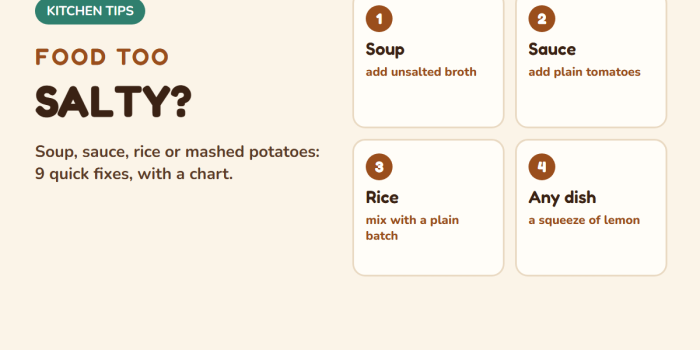
Short answer: you can’t pull salt back out of food, but you can spread it thinner. Soup or stew? Add unsalted broth or water, plus more vegetables or beans. Sauce? Add more of the unsalted base, like a can of plain tomatoes. Rice, mashed potatoes or stuffing? Mix in a fresh, unsalted batch. Then a squeeze of lemon, a splash of cream or a knob of unsalted butter makes what’s left taste softer.
Below you’ll find a quick chart, then a fix for each dish, so dinner (or the Thanksgiving table) is saved.
On this page: The chart · The 9 fixes · Make salt taste softer · Thanksgiving rescue · How to avoid it · Quick questions
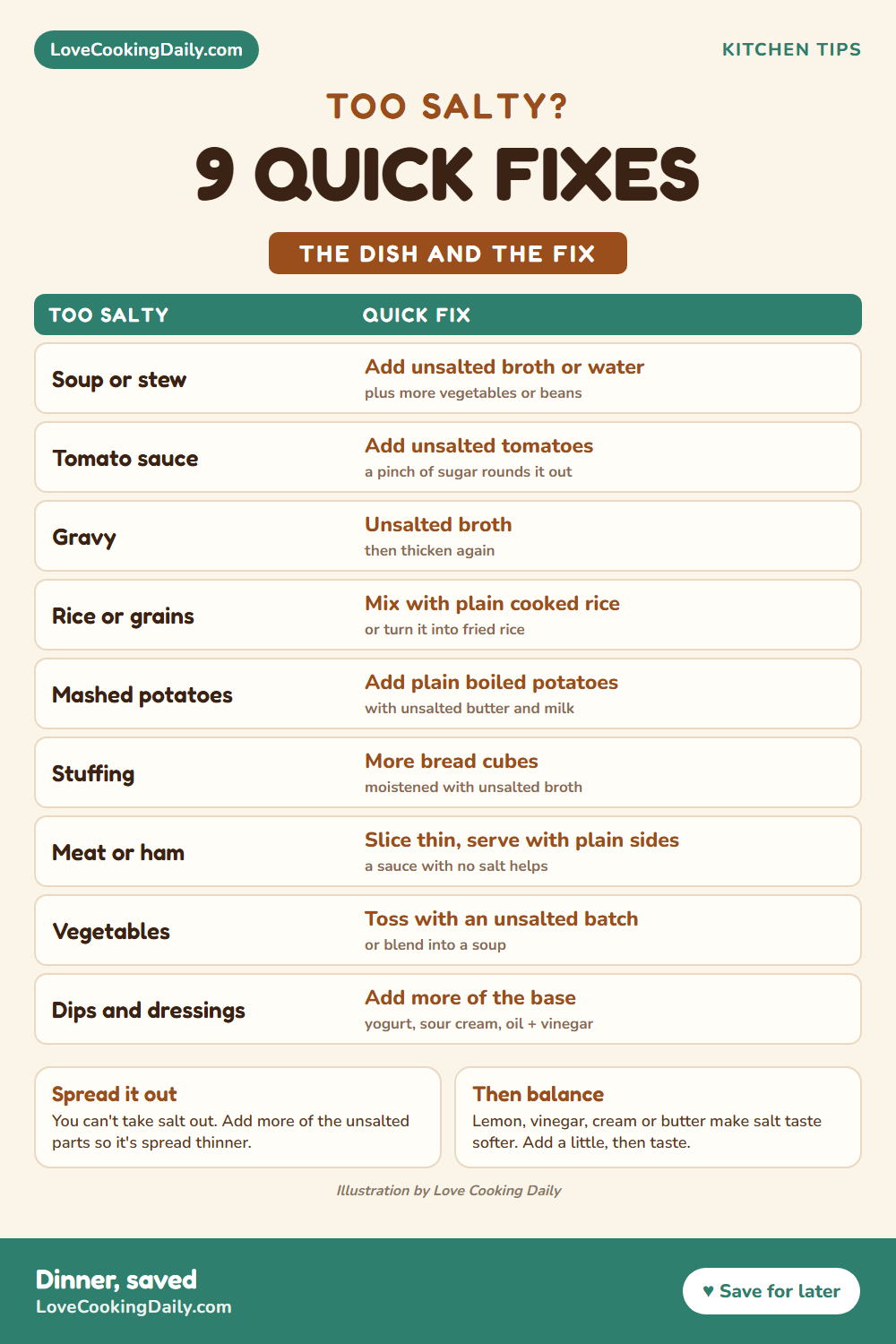
Too salty chart: the dish and the quick fix
| Too salty | Quick fix | Good to know |
|---|---|---|
| Soup or stew | Add unsalted broth or water, plus more vegetables or beans | Thicken again if it gets too thin |
| Tomato or pasta sauce | Add a can of unsalted crushed tomatoes | A pinch of sugar rounds out the taste |
| Gravy | Add unsalted broth, then thicken again | A splash of cream softens it |
| Rice or grains | Mix with a batch of plain cooked rice | Or turn it into fried rice with no soy sauce |
| Mashed potatoes | Add plain boiled potatoes | Use unsalted butter and milk |
| Stuffing | Add more bread cubes and unsalted broth | Bake it a little longer to crisp the top |
| Meat or ham | Slice thin, serve with plain sides | A sauce with no salt helps |
| Vegetables | Toss with an unsalted batch | Or blend them into a soup |
| Dips and dressings | Add more of the base | Yogurt, sour cream, or oil and vinegar |
The 9 fixes, explained
1. Soup or stew too salty
This is the easiest one to save, because soup is mostly liquid. Ladle out a cup or two of the salty broth (keep it in the freezer to use later in a bigger batch), and replace it with unsalted broth or water. Then add more of what’s already in the pot: another chopped potato, a handful of carrots, a can of rinsed beans or some more meat. Every new ingredient comes in with no salt and shares out what’s there. If the soup gets thin, simmer it a few minutes uncovered, or thicken it with a little slurry; our cornstarch substitute chart has the swaps if you’re out.
Don’t just boil it down to “cook off” the salt. Water evaporates, salt doesn’t, so a long boil makes soup saltier.
2. Tomato or pasta sauce too salty
Add a can of plain, no-salt-added crushed tomatoes or tomato sauce, and simmer it together. If the sauce gets too loose, a spoon of unsalted tomato paste thickens it again. Tomatoes are sharp, so a small pinch of sugar or a grated carrot can round out the taste. A splash of cream turns it into a rosé sauce and softens the salt even more. Serve it over unsalted pasta, and go easy on the parmesan, which is salty too.
3. Gravy too salty
Same idea: dilute it with unsalted broth or water, then thicken it again with a little slurry. A splash of cream helps too. Drippings and store-bought broth often carry a lot of salt, so taste before you season. Our how to fix gravy guide covers thin, lumpy and greasy gravy as well.
4. Rice or grains too salty
Cook a second batch of rice (or quinoa, couscous, farro) with no salt at all, and fold the two together. Half and half usually brings it right back. Too much to eat? Salty rice freezes well, and it’s perfect for fried rice the next day, because the cold rice fries up crisp. Just leave out the soy sauce, or use a low-sodium one.
5. Mashed potatoes too salty
Boil a few more potatoes with no salt in the water, mash them, and stir them into the salty batch. Use unsalted butter and plain milk or cream to bring it all together. Sour cream or cream cheese also softens the salt and makes them extra creamy. Need a recipe to start from? Try these garlic mashed potatoes with sour cream.
6. Stuffing too salty
Stuffing is often salty because bouillon, sausage and stock all add salt at once. Toast more plain bread cubes, moisten them with unsalted broth, and mix them in. Extra chopped celery, onion and a handful of fresh herbs help too. Bake it a few minutes longer so the top crisps up again. If you’re making it from scratch, start from a recipe like this sausage and herb stuffing and taste before the final salt goes in.
7. Meat or ham too salty
Once meat is cooked, the salt is inside, so the fix is how you serve it. Slice it thin, and serve it with plenty of plain sides: unsalted potatoes, rice, bread or a fresh salad. A sauce with no salt, like a creamy mushroom sauce or a fruit sauce, balances each bite. Very salty ham can go into a pot of beans or soup, where it seasons the whole batch instead of being eaten in thick slices. For an easy way to finish a ham, see this easy ham glaze.
Planning ahead? Salt-cured country hams are meant to be soaked in cold water before cooking, usually overnight or longer, changing the water now and then. Follow the directions on the package.
8. Vegetables too salty
Roast or steam a batch of the same vegetables with no salt, and toss the two together. A squeeze of lemon and a drizzle of olive oil help too. Too many to fix? Blend them with unsalted broth into a quick soup, where the extra liquid spreads the salt out.
9. Dips and dressings too salty
Add more of the base. For a creamy dip, that’s more plain yogurt, sour cream or cream cheese. For a vinaigrette, add more oil and vinegar in the same ratio. A mashed avocado or a handful of chopped fresh herbs also stretches a salty dip. Out of sour cream? Our sour cream substitute chart has the swaps.
Make salt taste softer (after you’ve spread it out)
These don’t remove salt, but they change how salty the food tastes. Add a little, stir, and taste before adding more.
- Acid: a squeeze of lemon or lime, or a few drops of vinegar. This is the quickest trick for soups, sauces and vegetables.
- Fat and dairy: a splash of cream, a knob of unsalted butter, a spoon of sour cream or plain yogurt. Great in soups, sauces and mashed potatoes. No cream? See our heavy cream substitute chart.
- A little sweetness: a pinch of sugar or a spoon of honey, mostly in tomato sauces and glazes. Don’t overdo it.
- Fresh herbs: chopped parsley, basil, dill or chives add fresh flavor so the salt stands out less.
What about the raw potato trick? Dropping a potato into salty soup to “soak up” the salt does very little. The potato takes in some liquid, salt and all, but not enough to fix a pot. Adding more liquid and ingredients works much better.
Thanksgiving rescue: what to do on the day
On a big cooking day, salt sneaks in from every side: brined turkey, salty drippings, stock, bouillon cubes, butter and cheese. If something tastes too salty:
- Gravy: keep a carton of unsalted broth next to the stove and use it to thin and fix. Then thicken it again.
- Stuffing: keep a bag of plain bread cubes on hand to stir into a salty batch.
- Mashed potatoes: boil a few extra potatoes with no salt, just in case.
- Turkey: if a brined bird is salty, slice it thin and pair it with unsalted mashed potatoes and fresh cranberry sauce, whose sharp taste balances the salt.
Getting ready for the big day? See how to thaw a turkey, and for the day after, how long leftover turkey lasts.
How to avoid it next time
- Salt in small steps. Add a little, taste, then add more. You can always add salt; you can’t take it out.
- Season at the end. Soups, stews and sauces get saltier as they reduce. Salt them after they’ve simmered down.
- Count the salty ingredients. Broth, bouillon, soy sauce, bacon, sausage, ham, cheese, olives and capers all bring their own salt.
- Buy low-sodium broth. It gives you control. You can season it yourself at the end.
- Know your salt. Table salt is much saltier by the spoon than flaky kosher salt, because the grains pack tighter. If a recipe says kosher salt and you use table salt, use less.
- Taste before serving. Taste from a clean spoon just before it goes on the table, when there’s still time to fix it.
Want to practice on a pot that forgives? Try one from our cozy fall soup recipes, this superb beef stew or an easy crock pot ham and bean soup, a great home for a ham that came out too salty.
Quick questions
How do you fix soup that is too salty?
Add unsalted broth or water, then add more of the soup’s own ingredients, like potatoes, vegetables, beans or meat. Finish with a squeeze of lemon or a splash of cream. Don’t boil it down, which makes it saltier.
Does a potato absorb salt?
Not much. A raw potato in salty soup takes in some of the liquid, but it doesn’t pull out enough salt to fix the pot. Adding more unsalted liquid and ingredients works better.
Does sugar cancel out salt?
No, but a small pinch can make salty food taste rounder, especially tomato sauces. Lemon juice or vinegar usually helps more.
Can you fix food that’s too salty after it’s cooked?
Yes, most of the time. Spread the salt out by adding more of the unsalted parts, then balance the taste with acid, dairy or fresh herbs. Meat is the hardest, so slice it thin and serve it with plain sides.
Why does my food come out too salty?
Usually salty ingredients add up (broth, bouillon, bacon, cheese), food reduces and gets saltier, or a recipe written for kosher salt was made with table salt. Season at the end and taste as you go.
Kitchen Kit
- A salt cellar with a lid, so you season by the pinch instead of shaking from the box
- A set of measuring spoons, for salting in small, even steps
- A stick blender, to turn salty vegetables into a quick soup
As an Amazon Associate I earn from qualifying purchases.
You might also like
- How to Fix Gravy: Thin, Lumpy, Salty or Greasy (8 Quick Fixes With Chart)
- Cornstarch Substitute: 8 Easy Swaps for Gravy, Pie and Sauces (With Chart)
- Heavy Cream Substitute: 8 Easy Swaps (With Chart)
- Sour Cream Substitute: 9 Easy Swaps (With Chart)
- How to Thaw a Turkey: Fridge & Cold Water Times (With Chart)

Pingback: 27 Cozy Fall Soup Recipes to Warm Up Your Week - Love Cooking Daily