
Short answer: almost every gravy can be saved in a few minutes. Too thin? Whisk 1 tablespoon of cornstarch into 1 tablespoon of cold water and stir it into the simmering gravy. Lumpy? Whisk hard, then pour it through a fine strainer. Too salty? Thin it with unsalted broth, then thicken it again. Greasy? Skim the fat off the top with a spoon.
Below you’ll find a quick chart, then each fix explained, so the gravy is ready when the turkey is.
On this page: The chart · The 8 fixes · Make it ahead · Mistakes to avoid · Quick questions
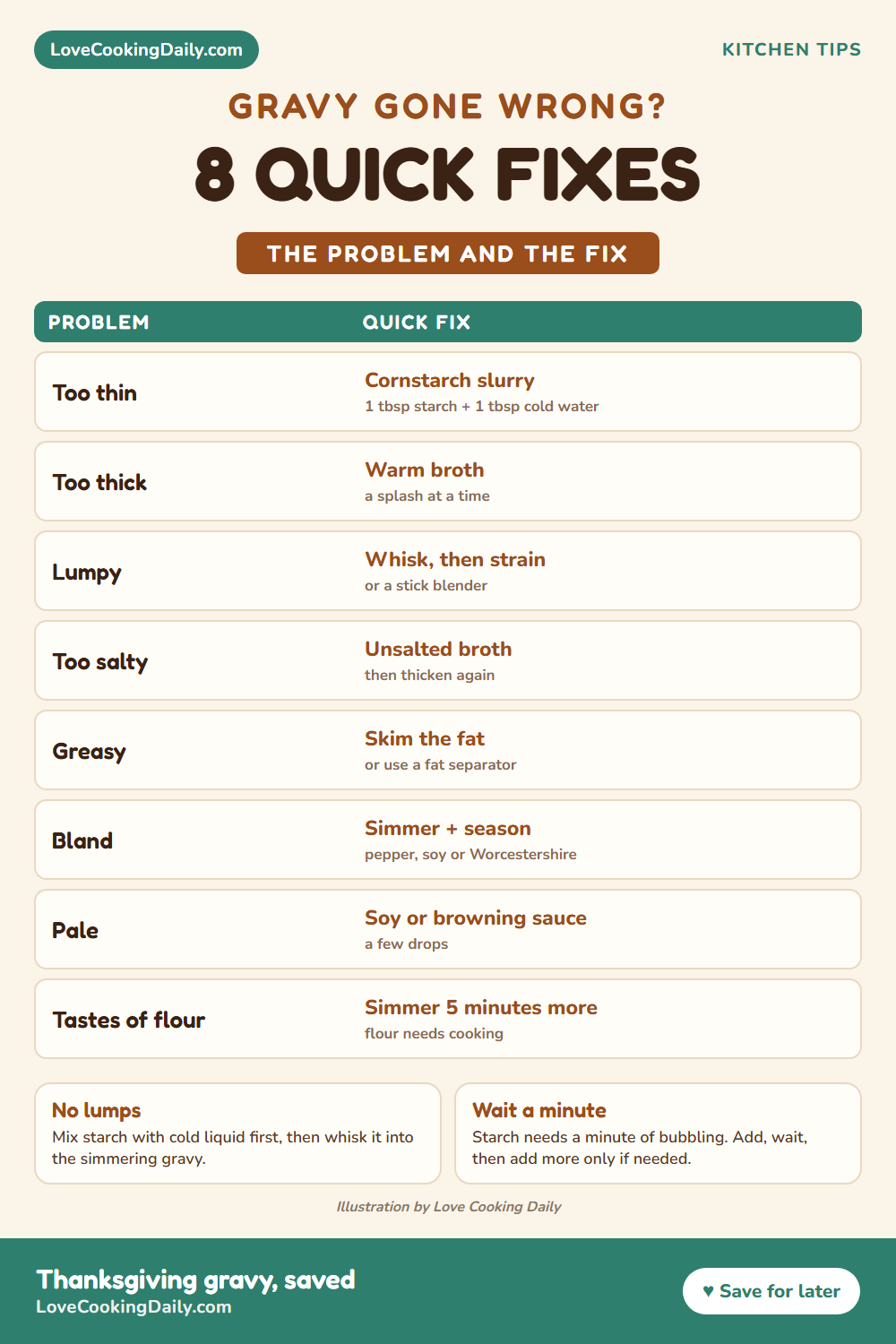
Gravy fix chart: the problem and the quick fix
| Problem | Quick fix | Good to know |
|---|---|---|
| Too thin | Cornstarch slurry: 1 tbsp cornstarch + 1 tbsp cold water per 1 to 2 cups of gravy | Let it bubble a minute before you add more |
| Too thick | Whisk in warm broth, a splash at a time | Gravy thickens as it cools, so stop a little thin |
| Lumpy | Whisk hard, then strain, or use a stick blender | Lumps come from dry flour hitting hot liquid |
| Too salty | Add unsalted broth or water, then thicken again | A splash of cream or lemon softens the salt taste |
| Greasy | Skim the fat with a spoon or fat separator | Or whisk in a little slurry to pull it together |
| Bland | Simmer to concentrate, add pepper, soy sauce or Worcestershire | Scrape up the browned bits in the pan |
| Pale | A few drops of soy sauce or browning sauce | Next time, cook the roux until it’s light brown |
| Tastes of raw flour | Simmer gently 5 more minutes | Flour needs cooking; cornstarch doesn’t |
The 8 gravy fixes, explained
1. Gravy too thin
This is the most common problem, and the fastest to fix. Make a slurry: whisk 1 tablespoon of cornstarch with 1 tablespoon of cold water or broth until smooth. Bring the gravy to a gentle simmer, pour the slurry in while you whisk, and let it bubble for a minute. That amount thickens about 1 to 2 cups of gravy. Still thin? Repeat, but wait a minute between additions, because starch takes a moment to do its work.
No cornstarch? Use 2 tablespoons of flour whisked into cold water instead, and simmer a few minutes longer. Our cornstarch substitute chart has the right amount for arrowroot, potato starch and the rest. Or skip the starch and simply simmer the gravy uncovered until enough water cooks off; this also makes it taste richer.
2. Gravy too thick
Whisk in warm broth, stock or the cooking liquid from the potatoes, a splash at a time, until it pours the way you like. Use warm liquid, not cold, so the gravy stays hot. Remember gravy keeps thickening as it sits on the table, so aim a little thinner than you want it to end up.
3. Lumpy gravy
First, whisk hard for a minute; small lumps often break up. If they don’t, pour the gravy through a fine-mesh strainer into a clean pan and press the lumps with the back of a spoon. A stick blender also makes lumpy gravy silky in seconds (blend in the pan, off the heat). Lumps happen when dry flour or starch lands in hot liquid, so next time see the mistakes below.
4. Gravy too salty
You can’t take salt out, but you can spread it thinner. Add unsalted broth or water to dilute the salt, then thicken the gravy again with a little slurry. A splash of cream, or a small squeeze of lemon juice, also softens how salty it tastes. The old trick of dropping in a raw potato to “soak up” the salt does very little, so don’t count on it. Pan drippings and store-bought broth are often already salty, so taste before you add any salt at all.
5. Greasy gravy
Fat floats. Tilt the pan and spoon it off the top, or pour the drippings into a fat separator before you start, which is the easiest way on Thanksgiving. If the gravy is already made and looks oily, let it sit a minute, skim, then whisk in a small slurry: the extra starch helps pull the fat and liquid back together.
6. Bland gravy
Simmer it a few minutes more to concentrate the flavor. Then add black pepper, a pinch of dried thyme or sage, and a few drops of soy sauce or Worcestershire sauce for depth. Make sure you scraped up the browned bits stuck to the roasting pan; that’s where most of the flavor is. A spoonful of cold butter whisked in at the very end makes it taste rounder and look glossy.
7. Pale gravy
Gravy made from turkey drippings is sometimes more beige than brown. A few drops of soy sauce or a browning sauce darken it without changing the taste much. Next time, cook the flour and fat together (the roux) for a few extra minutes, stirring, until it turns light brown before you add the liquid.
8. Gravy tastes of raw flour
Flour needs cooking. If your gravy tastes pasty or chalky, keep it at a gentle simmer for about 5 more minutes, stirring now and then, and the raw taste goes away. Cornstarch doesn’t have this problem, which is one reason some cooks prefer it for last-minute fixes.
Make gravy ahead (and reheat it smoothly)
Gravy is one of the easiest things to take off your plate on a busy day. Make it a day or two ahead with broth, cool it, and keep it covered in the fridge. It will set almost solid; that’s normal. Reheat it in a pan over low heat, whisking, and add a splash of warm broth until it loosens. When the turkey comes out, stir a few spoonfuls of the fresh drippings in for flavor. For timing the bird itself, see how to thaw a turkey, and for the day after, how long leftover turkey lasts.
Want to practice before the big day? Try a weeknight gravy like country gravy with sausage and bacon, chicken smothered in onion and garlic gravy or crock pot cubed steak with gravy.
Mistakes to avoid
- Dumping dry flour or cornstarch into hot gravy. It clumps at once. Mix it with cold liquid first, or cook flour in the fat as a roux.
- Adding more thickener too soon. Starch needs a minute of bubbling to thicken. Add, wait, then decide.
- Salting before you taste. Drippings and broth bring their own salt. Season at the end.
- Leaving all the fat in. A little fat carries flavor; a layer of it makes gravy greasy. Skim or separate it.
- Boiling hard for a long time. A gentle simmer is enough. Long, hard boiling can make a starch-thickened gravy go thin again.
- Making it at the last minute. Make it ahead with broth and finish it with fresh drippings.
Quick questions
How do you thicken gravy without cornstarch?
Use 2 tablespoons of all-purpose flour whisked into cold water for every tablespoon of cornstarch, and simmer a few minutes longer. Potato starch, arrowroot and even instant potato flakes work too; the cornstarch substitute chart has the amounts.
Why is my gravy lumpy?
Dry flour or starch met hot liquid and formed little balls, or the liquid went in too fast. Whisk hard, strain it, or blend it smooth.
Can I fix gravy that’s too salty?
Yes. Add unsalted broth or water to dilute it, thicken it again, and finish with a splash of cream. The raw potato trick does very little.
Can I make gravy creamy?
Stir in a few spoonfuls of cream or milk at the end and warm it through without boiling. Out of cream? See our heavy cream substitute chart.
How long does gravy last in the fridge?
Homemade gravy keeps about 3 to 4 days in a covered container in the fridge. Bring it to a full simmer before serving again.
Kitchen Kit
- A flat gravy whisk, to reach the corners of the roasting pan and stop lumps
- A gravy fat separator, for smooth, non-greasy gravy from the pan drippings
- A fine-mesh strainer, the quickest rescue for lumpy gravy
As an Amazon Associate I earn from qualifying purchases.
You might also like
- Cornstarch Substitute: 8 Easy Swaps for Gravy, Pie and Sauces (With Chart)
- How to Thaw a Turkey: Fridge & Cold Water Times (With Chart)
- How Long Does Leftover Turkey Last? (Fridge & Freezer Chart)
- Pumpkin Pie Spice Substitute: 8 Easy Swaps (With Chart)
- Heavy Cream Substitute: 8 Easy Swaps (With Chart)