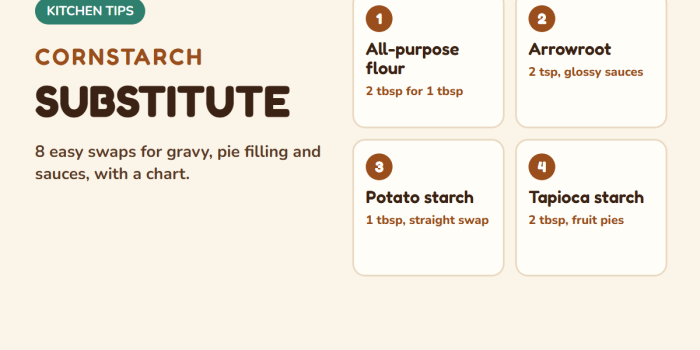
Short answer: the easiest cornstarch substitute is the flour you already have. For every 1 tablespoon of cornstarch, use 2 tablespoons of all-purpose flour and let the sauce simmer a few minutes longer. For a clear, glossy fruit pie filling, use 2 tablespoons of tapioca starch or 2 teaspoons of arrowroot instead.
Below you’ll find a quick chart, then each swap explained, which one to use in gravy, pie, stir-fry sauce, pudding and stew, and the mistakes that make a sauce lumpy or thin.
On this page: The chart · What cornstarch does · The 8 swaps · Lump-free every time · Recipe by recipe · Mistakes to avoid · Quick questions
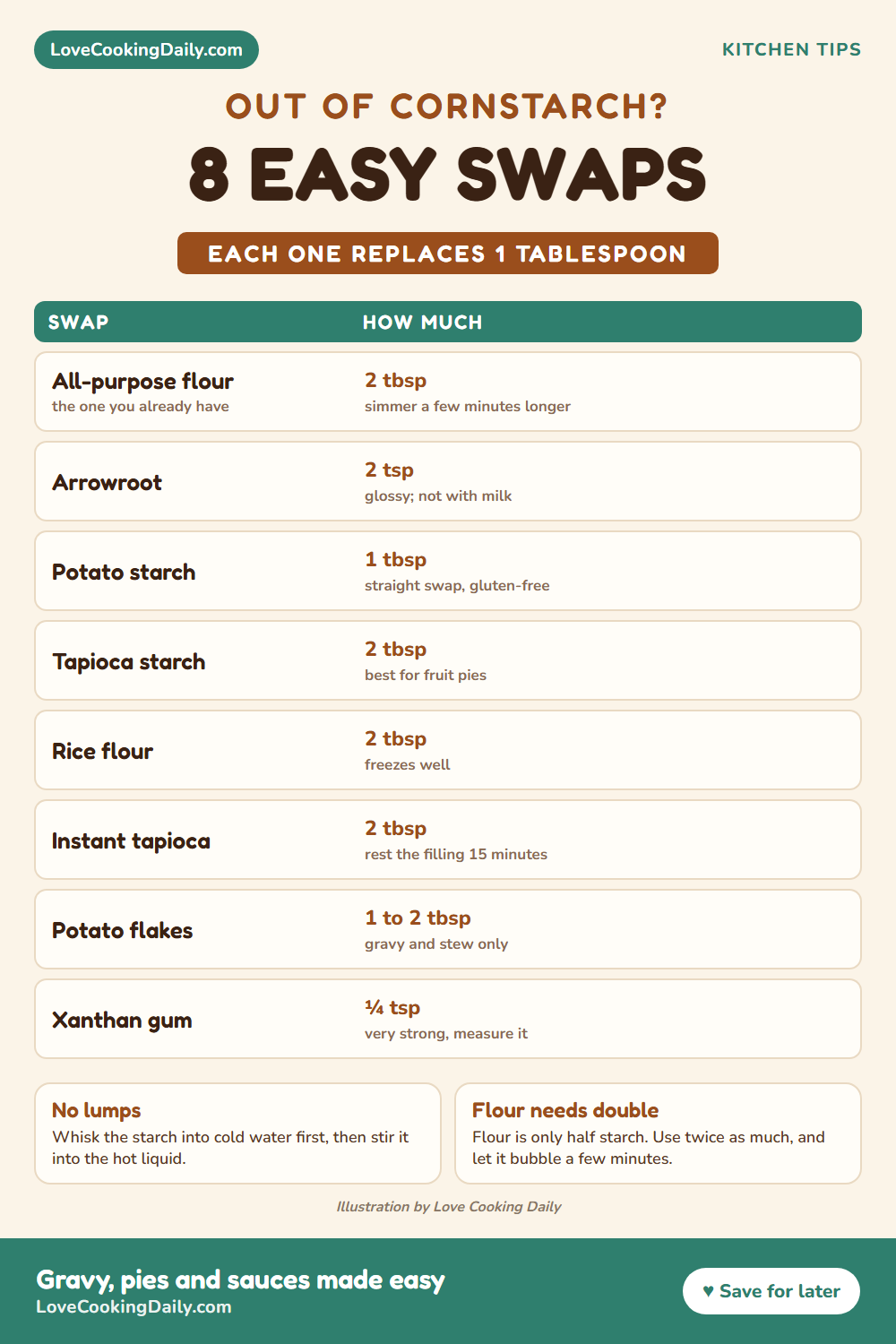
Cornstarch substitute chart: what replaces 1 tablespoon
Every amount below replaces 1 tablespoon of cornstarch used to thicken. If your recipe asks for 2 tablespoons, double it. A tablespoon is 3 teaspoons, and our guide to how many teaspoons are in a cup will help with bigger amounts.
| Swap | Replaces 1 tablespoon | Best in | Watch out for |
|---|---|---|---|
| All-purpose flour | 2 tbsp | Gravy, stew, pot pie, creamy sauces | Cloudy, not glossy; simmer a few minutes so it doesn’t taste floury |
| Arrowroot | 2 tsp | Fruit sauces, glazes, stir-fry sauce | Add at the end; turns slimy with milk or cream |
| Potato starch | 1 tbsp, straight swap | Gravy, soups, stir-fry, crispy coatings | Don’t boil it hard or long, or it thins again |
| Tapioca starch | 2 tbsp | Fruit pies, cobblers, puddings | Can turn stringy if boiled too long |
| Rice flour | 2 tbsp | Soups, sauces you plan to freeze | Slightly cloudy; use white rice flour, not glutinous |
| Instant tapioca | 2 tbsp | Fruit pie fillings | Let the filling sit 15 minutes before baking |
| Instant potato flakes | 1 to 2 tbsp, a little at a time | Gravy, stew, chowder | Adds potato taste; savory dishes only |
| Xanthan gum | ¼ tsp | Gluten-free sauces and dressings | Very strong; too much turns gummy |
What cornstarch does in a recipe
Cornstarch is the pure starch from corn. When it meets hot liquid, the starch grains swell up and thicken whatever they’re in. That’s all it does in gravy, pie filling, pudding and sauces: it turns a runny liquid into a thick one. It’s also gluten-free, has no taste, and leaves a sauce shiny and see-through.
So the trick to swapping is simple: reach for another starch. Every swap on this list thickens the same way. They differ in three things: how much you need, how clear and glossy the result is, and how much heat they can take before they give up.
Cornstarch also shows up in two other jobs. In crispy coatings for fried chicken or tofu it makes the crust crunchy, and in some cookies and shortbread it makes them tender. We cover both in the recipe by recipe section.
The 8 cornstarch swaps, explained
1. All-purpose flour (the one you already have)
Flour is about half starch, so you need twice as much: 2 tablespoons of flour for every tablespoon of cornstarch. It’s the classic thickener for gravy and stew, and it gives a creamy, cloudy look instead of a glossy one. The one rule is to cook it: let the sauce bubble gently for a few minutes after it thickens, or it can taste of raw flour. Flour is not gluten-free.
2. Arrowroot
Arrowroot is the closest match to cornstarch. It’s a fine white powder that thickens at a lower heat and leaves a sauce clear and shiny, so it’s lovely in fruit sauces, glazes and sweet-and-sour sauce. Use 2 teaspoons for every tablespoon of cornstarch. Stir it in near the end, because long boiling weakens it. Skip it in milk or cream sauces: dairy can make it slimy.
3. Potato starch
Potato starch swaps in tablespoon for tablespoon. It thickens fast and well, with a glossy finish, and it’s gluten-free. It doesn’t like long, hard boiling, so add it once the sauce is nearly ready and take it off the heat as soon as it’s thick. It also makes a very crispy coating for frying. (Potato starch is not the same as potato flour, which is heavier and tastes of potato.)
4. Tapioca starch
Tapioca starch, sometimes sold as tapioca flour, comes from the cassava root. Use 2 tablespoons for every tablespoon of cornstarch. It gives fruit pies and cobblers a clear, glossy filling and holds up well in the freezer. Boiled too long it can turn a little stringy, so it’s best in things that bake or simmer gently.
5. Rice flour
White rice flour thickens soups and sauces with almost no taste. Use 2 tablespoons for every tablespoon of cornstarch. It looks slightly cloudy, but sauces made with it freeze and reheat without going watery. Use plain white rice flour; “sweet” or glutinous rice flour behaves differently and turns sticky.
6. Instant (quick-cooking) tapioca
These are the little granules in the baking aisle, made for pie fillings. Use 2 tablespoons for every tablespoon of cornstarch, stir them into the fruit, and let the filling sit for about 15 minutes before it goes into the crust so the granules can soften. If you don’t like seeing tiny clear dots in your pie, grind the granules in a spice grinder first.
7. Instant mashed potato flakes
Not elegant, but it works. A spoonful of instant potato flakes thickens gravy, stew and chowder in seconds. Start with 1 tablespoon, stir, wait a minute, and add more only if you need it. It adds a little potato taste, so keep it for savory dishes.
8. Xanthan gum
Gluten-free bakers often have a bag of xanthan gum in the cupboard. It’s extremely strong: ¼ teaspoon does the work of a whole tablespoon of cornstarch. Sprinkle it over the liquid while you whisk, so it doesn’t clump. Too much makes a sauce gummy and slick, so measure it.
How to thicken without lumps
Starch dropped straight into hot liquid clumps into little balls that never dissolve. Whichever swap you use, do this:
- Cornstarch, arrowroot, potato, tapioca or rice starch: whisk the starch with an equal amount of cold water or broth until smooth. That’s a slurry. Pour it into the simmering liquid while you stir.
- Flour: either whisk it with cold liquid the same way, or cook it in the fat first (butter or pan drippings) for a minute or two before adding the liquid. That’s a roux, the base of most homemade gravy.
- Xanthan gum and potato flakes: sprinkle them in a little at a time while you whisk.
- Give it a minute. Most starches thicken as soon as the liquid is hot, but everything thickens a bit more as it cools. Stop when it’s slightly thinner than you want.
Which swap to use, recipe by recipe
- Thanksgiving turkey gravy: flour, made as a roux in the pan drippings, is the traditional choice and tastes the richest. Potato starch is the quick gluten-free option. Still need the bird? Here’s how to thaw a turkey safely in time.
- Country and onion gravy: flour, every time. Try our country gravy with sausage and bacon or chicken smothered in onion and garlic gravy.
- Apple, cherry and berry pies: tapioca starch or instant tapioca for a clear, glossy filling; flour if that’s all you have (the filling will look cloudier). Good in these little apple pies or an apple cobbler.
- Stir-fry and takeout-style sauces: arrowroot or potato starch, for that shiny restaurant finish. Try it in beef and broccoli stir fry or an orange chicken sauce. New to the wok? Start with our stir-frying basics.
- Puddings and custards: tapioca starch, or flour cooked gently for a few minutes. Avoid arrowroot here, because of the milk. Good in a creamy chocolate pudding.
- Beef stew, soups and pot pie: flour or instant potato flakes. Rice flour if you’re making a big batch for the freezer. Try a superb beef stew or a from-scratch chicken pot pie.
- Crispy coatings for frying: potato starch is the best swap, then rice flour. Plain flour works but gives a softer crust.
- Cookies and shortbread: when a recipe adds a spoonful of cornstarch for tenderness, use the same amount of potato starch, or just leave it out and use flour; the cookies will be a little less soft.
- No starch at all? Simmer the sauce uncovered so some of the water cooks off, or stir in a spoonful of cream, cheese or mashed vegetables. Out of cream too? See our heavy cream substitute chart.
Mistakes to avoid
- Adding dry starch to hot liquid. It clumps instantly. Make a slurry with cold liquid first.
- Swapping one for one with flour. Flour needs twice as much as cornstarch. One tablespoon for one tablespoon leaves you with thin gravy.
- Not cooking the flour. A flour-thickened sauce needs a few minutes of gentle bubbling, or it tastes pasty.
- Boiling arrowroot or potato starch for too long. Both thicken quickly, then thin out again with long, hard boiling. Add them near the end.
- Arrowroot in a cream sauce. Dairy can turn it slimy. Use flour or potato starch instead.
- Adding more too soon. Sauces keep thickening as they cool. Wait a minute between spoonfuls.
- Guessing with xanthan gum. A little too much turns a sauce slick and gummy. Measure the ¼ teaspoon.
Quick questions
Can I use flour instead of cornstarch?
Yes. Use 2 tablespoons of all-purpose flour for every tablespoon of cornstarch, and simmer the sauce a few minutes longer. It will look creamy rather than glossy, and it won’t be gluten-free.
Is cornstarch the same as corn flour?
In the US, no. Cornstarch is the pure white starch; corn flour is finely ground whole corn and doesn’t thicken the same way. In the UK and Australia, though, “cornflour” is the name for cornstarch, so a British recipe that says cornflour means cornstarch.
What’s the best gluten-free substitute for cornstarch?
Potato starch is the easiest, because it swaps tablespoon for tablespoon. Arrowroot, tapioca starch and white rice flour are gluten-free too. Check the label if you cook for someone with celiac disease, since some brands are packed alongside wheat.
Can I use baking powder or baking soda instead of cornstarch?
No. They make doughs and batters rise; they don’t thicken anything, and they’d make a sauce taste soapy or salty.
How do I fix gravy that’s too thin?
Whisk 1 tablespoon of cornstarch, or one of the swaps above in the right amount, with the same amount of cold water. Stir it into the simmering gravy and let it bubble for a minute. Repeat only if it’s still too thin after it has cooked.
Kitchen Kit
- Arrowroot powder, the closest swap for glossy sauces and pie fillings
- A flat gravy whisk, to reach the corners of the roasting pan and stop lumps
- A gravy fat separator, for smooth Thanksgiving gravy from the pan drippings
As an Amazon Associate I earn from qualifying purchases.